Equinor Discovered Oil Deposits in the Barents Sea

The Norwegian company Equinor has discovered new oil deposits in the Polynya Tubåen subsoil area in the Barents Sea. This was reported by the company’s press service.
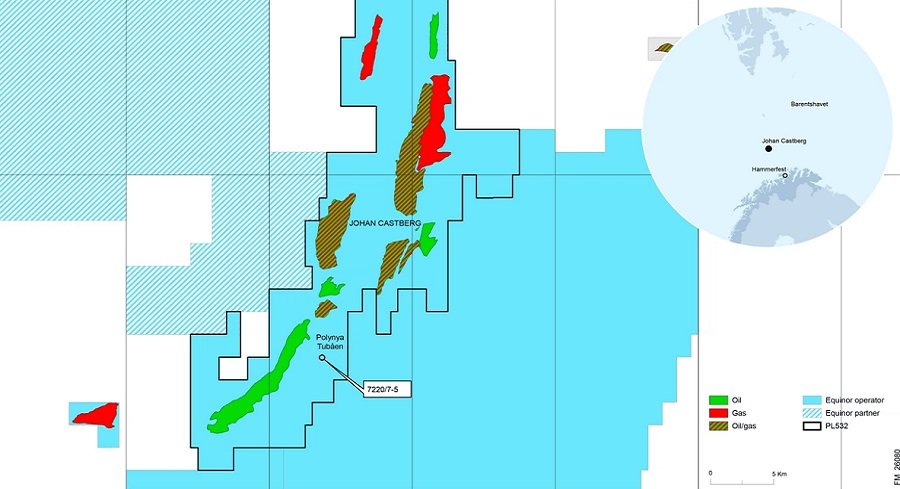
The new discovery was made during the drilling of exploration well 7220/7-5, located 16 km southwest of well 7220/8-1 at the Johan Castberg field, and 210 km northwest of the city of Hammerfest. Recoverable reserves are preliminarily estimated in the range of 14 to 24 million barrels of oil equivalent.
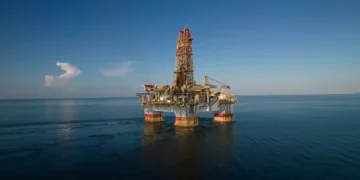
The work was carried out using the semi-submersible drilling rig COSL Prospector. The water depth in the area is 361 m, while the well depth is 1,119 m below sea level.
“A year ago, we discovered a new oil province, Johan Castberg, in the Barents Sea. It is encouraging that we are now making new discoveries in this area. In the future, we plan to drill 1–2 exploration wells per year in this region to increase the resource base and maintain a stable level of production over a longer period,” said G. B. Haaland, Senior Vice President for Exploration and Production North at Equinor.
Initially, the reserves of the Johan Castberg field were estimated at 500–700 million barrels, and Equinor plans to increase this figure by another 200–500 million barrels. It is recalled that in June 2025, the Drivis Tubåen oil discovery was made in the Castberg area with reserves of 13–20 million barrels.
Last week, according to Equinor, development of the Isflak field began — the first new subsoil area to be developed with a tie-back to the Johan Castberg infrastructure. Its recoverable oil reserves amount to approximately 46 million barrels.
Johan Castberg Facts
- the field is located in the Norwegian sector of the Barents Sea, approximately 100 km north of the Snøhvit field, 240 km from Melkøya, and 150 km from Goliat;
- it covers blocks 7219/9 and 7220/4, 5, 7;
- the water depth in the area ranges from 360 to 390 m;
- it includes three fields: Skrugard (discovered in April 2011), Havis (January 2012), and Drivis (May 2014);
- the development and operation plan was approved in June 2018;
- the development concept предусматривает the use of the Johan Castberg FPSO, to which 30 wells (including 18 horizontal production wells and 12 injection wells) will be tied back, distributed across 10 subsea production systems;
- license holders: Equinor Energy AS (operator) — 46.3%, Vår Energi ASA — 30%, Petoro AS — 23.7%.