Gazprom Neft: Arctic Routes

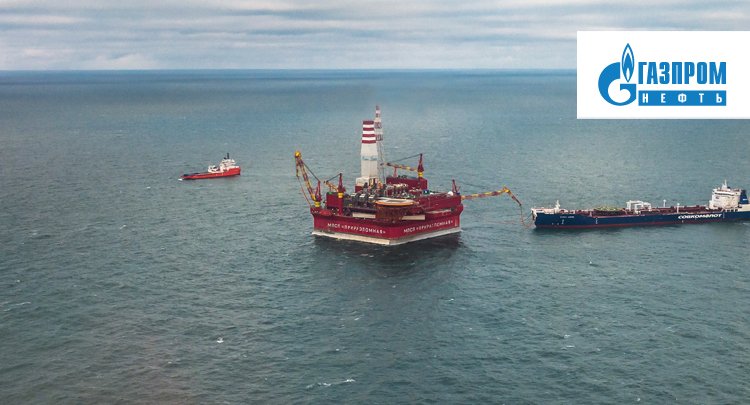
Prirazlomnoye Field Development Project: Transportation and Logistics
Offshore production is an extremely challenging and resource-intensive process. It’s not just the construction of the complex process platform, from which the drilling is performed and where people involved in the field’s development live and work. It is the establishment of the continuous logistic scheme to guarantee stable facility operation, which is a difficult task as well. One can easily imagine how many additional problems arise when it comes to transportation in an Arctic ice harsh location.
Offshore Supplies
The transportation scheme of any offshore project can be divided into three main constituents: delivery of cargoes to the platform to support operation and personnel needs, transportation of produced oil and transportation of personnel.
To understand the scale of operations, we should estimate the quantity of materials and equipment to be delivered to the platform for the construction and operation of only one well. 4.2 thousand tons is an average estimate per well. It is the equivalent of a large train loaded with pipes, chemicals and bulk materials, etc. required for well construction. This figure may vary a little depending on the well type (production, injection, cuttings), methods of recovery enhancement, etc. The construction of 32 wells is planned according to the Prirazlomnoye field development concept.
However, this is not the major part of the cargo traffic from the onshore base in Murmansk to the platform installed in the Pechora Sea. For example, almost 30 thousand tons of drinking water and approximately 25 thousand tons of diesel fuel were delivered to the Prirazlomnaya platform last year. The total cargo moved to date is100 thousand tons. This includes approximately 12 thousand tons of cuttings that were transported from the platform to the shore because the Prirazlomnaya platform operation principle envisages zero discharges.
The volume of oil to be transported from Prirazlomnaya will amount to about 2 million tons this year, and after 2020, when the field reaches the planned peak production performance, this figure will increase to 5 million tons. All operations necessary for the preparation, storage and shipment of crude oil are carried out directly on the offshore ice-resistant fixed platform, so the transportation and logistic scheme of the project is based on marine transport.

Onshore Support
Many offshore production facilities operate all over the world, so the transportation and logistic schemes for such projects have been developed and tried and tested long ago. The transportation scheme for the Prirazlomnoye field development project would be nothing out of the ordinary if it was not for the climate the platform operates in. “We work in harsh weather and ice conditions. Moreover, the platform is located far from the onshore supply base”, says Oleg Sokolov, Deputy Head of Transportation Support Department in Gazprom Neft-Shelf.
The onshore base located on the Kola Bay coast near Murmansk it is 980 km away from the platform. To be more specific, there are several bases used for transportation of cargoes for Prirazlomnaya platform. These are leased by Gazprom Neft from third parties. Gazprom Neft-Snabzhenie, a specialized company, is responsible for delivery of materials, equipment and foodstuff from all parts of the country and from around the world as well as for warehousing logistics, i.e. for onshore project support. However it is evident that working from several distant bases is not an optimum solution, even if utilizing a single operator. So the company assessed the possibility of constructing its own onshore base in Murmansk which could serve this and other offshore projects for the company.
The Company operates one more transport terminal in the Kola Bay on the route of oil transportation from the field to the European ports. The very Large Crude Carrier Umba with 300,259 t dead weight is installed in a roadstead. Crude oil from the Prirazlomnoye field is transported by the shuttle tankers serving the field. Umba is used for oil storage, customs clearance and border control. After all formalities are completed, the oil is loaded onto the end-users’ tankers. This scheme allows the Prirazlomnoye tankers to reduce the number of round trips considerably – from 3,500 to 1,070 nautical miles per trip and thus increase the frequency of shipments while not increasing the number of tankers. Moreover, the transportation terminal allows the buyers to use standard non-ice class vessels for ARCO oil transportation. Only special sea going vessels capable of cutting their way through the ice up to 1.5 m thick are to be utilized to reach the ice-free Kola Bay from the Pechora Sea coast.

Ice Class
All Prirazlomnoye field vessels are capable of operating in the ice conditions. Two shuttle tankers (Kirill Lavrov and Mikhail Ulyanov) were constructed specifically for this project and have ice class Arc 6. Support vessels Yury Topchev and Vladislav Strizhov, constructed simultaneously with the platform, have ice class Icebreaker 6. But these vessels are noted not only for the ice breaking features.
“The tankers are equipped with the unique oil transfer system. A dynamic positioning system allows the vessels to moor and pump oil from the Prirazlomnaya platform unloading module via the bow loading gear while staying away from the platform” – says Oleg Sokolov.
However, according to Konstantin Surikov, Deputy Head of the Fleet Operation Department in Gazprom Neft-Shelf, environmental limitations have to be taken into account regardless of the state-of-the-art equipment: “Ice near the platform is drifting and we have to wait for the weather windows to pump the oil. These windows last for maximum six hours; then the current changes direction and ice squeezing against the tanker prevents it from holding the loading position. So the vessel has to disconnect and retreat until the conditions are favorable again”.
Support vessels are also involved in shipments. One stand-by vessel stays in the operations areas as stipulated by the OSR plan.
“We equipped our vessels with additional equipment for oil spill recovery in ice conditions, says Konstantin Surikov. All project support vessels are interchangeable. As and when necessary, various special modules can be installed on any vessel and removed if the vessel is on the cargo trip”.
“Today we have a fleet sufficient as to its functions and quantity, summarized Oleg Sokolov. In terms of the future, our company and Krylov State Scientific Center assess the requirement for additional ice breakers considering the production program, changes in the ice conditions and other factors. To estimate the need in support vessels, we planned cargo traffic up to 2038, taking into account the well commissioning schedule and available statistical data, calculated the required deck and cargo hold area and now have an aggregate but complete picture. The main cargo traffic is expected up to 2023. The fleet composition will be changed as necessary thereafter”.
Air Routes
Sea transportation is relatively inexpensive and allows shipment of huge cargo volumes, but it has one major drawback – it takes much time. Thus, aviation is the only option to resolve urgent transportation tasks on the shelf projects.
Sure enough there are certain restrictions. For example, the length of the takeoff strip at the Varandey airport that bridges the platform with the mainland is 1.7 km, so the airport can only accommodate small aircrafts with the take-off weight up to 25 t. For this reason Prirazlomnaya platform personnel is transported from Arkhangelsk, which is the project air support base, using AN-24 turbo-prop aircrafts. The airplanes are reliable but you can hardly call them state-of-the-art. The first AN-24 was commissioned back in 1959. Certainly, all aircrafts pass scheduled maintenance and repair and Gazprom Neft-Shelf conducts audits of the contractors’ airplanes but nothing lasts forever and the aircraft life will come to end in 2020.
There are no aircrafts to replace AN-24 and even if similar ones exist somewhere in the world, they are not certified in Russia. So the company is currently in active search for the ways to resolve the upcoming problem.
One of the options is to use an alternate airport in Naryan-Mar and transport people by helicopter to Varandey. But this is more expensive as the number of helicopter flights will be three times as many as the airplane flights (currently 8-11).
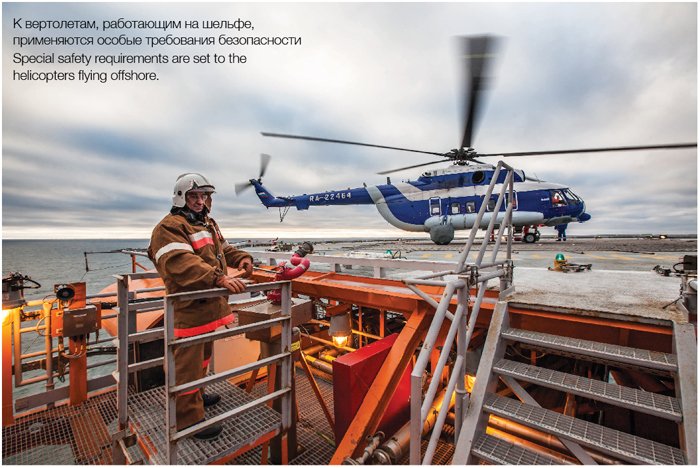
Rotating personnel is transported from Varandey to the platform by helicopters. Special requirements are set to these aircrafts as they fly over the sea. “In 2015 our company and Gazprom Avia completed an ambitious project involving the refurbishment of four MI-8 AMT helicopters flying to the Prirazlomnaya platform, said Alexander Voronin, Deputy Head of Logistics Department in Gazprom Neft-Shelf. We installed windows that can be broken outside, 16 chairs facing the direction of travel instead of benches along the sides, provided special cargo compartments for transportation of over-sized cargoes and installed ditching system”.
Today the company is constructing its own heliport in Varandey. The design passed state expert review and the plan is to commission the heliport in 2017-2018. “Considering that Varandey airport is private (owned by Lukoil – editor’s note), the expenses for airport use are high, says Oleg Sokolov. Moreover, the importance of our own heliport in the region increases when we think of future Arctic shelf projects. Because even now the passenger traffic counts almost 10 thousand people”.
Prirazlomnoye is the first and the only field in the Russian Arctic shelf where oil is produced. Commercial development of the field was commenced in December 2013. A new grade of oil (ARCO) came into the global market in April 2014. More than 10 million barrels of oil have been shipped since the commencement of field development.
Prirazlomnoye oil field is located in the Pechora Sea 60 km off the coast. Recoverable oil reserves amount at 70 million tons. The license holder is Gazprom Neft-Shelf, a subsidiary of Gazprom Neft.
Published with thanks to Gazprom Neft & Sibirskaya Neft MAGAZINE
Text by: Igor Sviriz