Technology Roundtable: Fracturing


1. With the sanctions currently restricting Russia’s development of hard to recover reserves, has there been any accidental impact on fracking operations for conventional reservoirs?
Weatherford: For conventional reservoirs, frac scopes have been reduced for all the contractors due to the plummeting oil prices. However, horizontal drilling and multi-stage fracturing have become more common in Russian fields thanks to its high efficiency in tight reservoirs. This positively affects the scope and number of jobs performed by Weatherford, including those performed on CT, or coiled tubing.
Halliburton: There has been no effect on conventional fracturing and all conventional frac work is been done on a regular basis and without interruptions so long as the respective project does not fall under the restricted end-use categories in accordance with the applicable laws and regulations, i.e. Offshore North of the Arctic Circle; Deepwater exploration or production greater than 500ft; Shale Oil and Gas Projects in Russian Federation.
Trican Well Service: Most hard to recover reserves projects were only at pilot stage when the sanctions were introduced so the impact on our Russian operations has been minimal and we do not anticipate any disruptions to our Russian business throughout the remainder of 2015 based upon the sanctions that have been imposed to date. However, we continue to monitor this situation closely as it does raise additional business risks in the region. So far sanctions had no impact on fracturing operations for conventional reservoirs, all our equipment is fully utilized and we continue to provide high quality fracturing services and technological solutions on the Russian market.
CATKoneft: Obviously, the imposed sanctions have had some impact on fracking operations for conventional reservoirs. In particular, the deliveries of imported equipment take more time now as we have to collect the documents and evidence showing that we do not carry out any activities that are in the sanction list. However, it’s not disastrous all in all. I believe a more negative impact on the Russian market’s state of affairs has been made by the weaker rouble against foreign currencies. Now the cost of equipment and components in the rouble equivalent has risen proportionally to the rouble weakening, i.e. virtually twice as much. Keeping in mind that all hi-tech equipment of frac fleets is made outside Russia, this has negatively influenced the current profitability of the oilfield service companies, because they have to continuously purchase the original components in order to maintain their proper performance capability. At the same time, for the last few years we have successfully conducted the programme of substitution of imported possible spare parts with Russian analogues. These are mostly pump valve units, valves and other consumables.
2. What is the current level of demand for single and multi-stage fracks in the region?
Weatherford: As I mentioned earlier, the market has experienced increased demand for multi-stage fracturing. As multi-stage fracking is one of the advanced and efficient technologies for horizontal drilling, the scope of which grows every year, the demand for this technology is growing in our country.
Halliburton: Currently more and more customers switch to horizontal drilling with multistage formation treatment. This strategy has proved its efficiency and subsequent cost-effectiveness. Every year multistage fracturing operations increase their share in the total scope of work. In 2012 Halliburton treated over 6.6% of all zones using multistage technologies such as RapidStage® sleeves, SurgiFrac, CobraMax and Plug&Perf. Compared to that, in 2013 over 17% of frac treatments were performed with multistage or similar technologies. In 2014 multizone treatments were 31% from total number accordingly. We should keep in mind that at this point there are lots of vertical wells drilled and are waiting for their turn to be stimulated with various treatment methods, though we predict that the number of such wells will be reduced in future.
Based on our experience with both simple and multizone wells we can say that wells should be constructed with due consideration for their entire operating life. Casing strings should be designed to withstand any pressures to ensure application of various well stimulation methods. Wells should be completed in such a way as to enable repeated stimulation and comprehensive well logging. Ideally, wells should be equipped with monitoring and control systems.
Trican Well Service: Since 2012, we have seen a 10 to 15 per cent increase in the number of multi-stage fracturing jobs across virtually all the oil and gas producing regions of Russian. First of all, this increase was due to the producing companies being interested in highly technological drilling combined with the new (for the Russian conditions) completion systems, using which lead to significant improvement of the hydrocarbon production results in comparison with the “conventional” technologies for directional wells. Now we can see the multi-stage frack jobs growth rate gradually dropping. For instance, in the first six months of 2015 the number of multi-stage frack jobs was 32% of the total number of frack jobs. We estimate that the ratio between the amount of multi-stage frack jobs and the total frack jobs may go up a few per cent by the end of this year, but we do not anticipate a substantial growth.
CATKoneft: I estimate the capacity of the reservoir fracturing market in Russia in this year as 12-13 thousand jobs, without OAO Surgutneftegaz that use their own service company. The share of multi-stage frac jobs for the last three-four years has gone up to almost 30 per cent and it’s likely to keep growing in the future. As for the next year, it’s difficult to say with certainty how the lower oil price will affect the budgets of the major Russian oil producers and their fracturing plans for 2016. Let’s hope that there will be no dramatic reduction in the number of fracks.
3. What are the top 3 most common causes of frack failure in the region? How can these be overcome?
Weatherford: Most common issues that shall be resolved to improve the efficiency of operations are as follows:
• Geological, associated with the lithology of the reservoir — more detailed studies of the formations are required to deal with these problems. This is where Weatherford innovative logging tools can help. Microseismic monitoring of hydrofrac allows the customer to get a comprehensive view of the reservoir. Exploration and production sectors of oil industry have been showing a special interest in this technology, as it enables the operators to optimize their completion plans, extend the production plateau and drain specific zones to increase oil recovery.
• Technical, or equipment malfunction. We need continuous control and timely maintenance of the equipment to overcome this problem.
• Technological, or human factor. Regular training of employees, holding safety meetings or job safety analysis will help prevent issues related to lack of competence, lack of familarity with the equipment or plain inattention on the job. Weatherford has always paid utmost attention to safety and personnel training, irrespective of geographic areas where the company operates.
Halliburton: The primary factor in failures is inadequate reservoir understanding as a result of lack of data. Our job is to work collaboratively with the customer to provide solutions tailored to their specific conditions.
Trican Well Service: I’d name three main causes: geology, equipment, and human factor. As the number of multi-stage frack jobs is increasing as well as the quality of the reservoirs on the candidate wells on most fields is worsening, the number of problems related to more complex operations is increasing too. The main problems are still the receiving of the STOP injection mode and the work abortion. The root cause is the complex geological environment related to the well drilling: high fluid filtration resistance, formation of complex man-caused fracture networks along the horizontal section of the hole, ultra-fast filtration of the fluid. From time to time we come across the problems related to assemblies for multi-stage frack jobs. In such cases it is quite difficult to carry out a root cause analysis because of insufficient information that would help identify such causes. Often, such problems can be only identified by the method of elimination. By all means, some unsuccessful jobs are caused by the failure of the frack equipment itself, but the percentage of such complications in our company is small and has not been changing for many years – thanks to the timely repair and maintenance of the equipment.
Also, we have succeeded in minimising the percentage of jobs that were not successful due to the human factor. Our company gives high priority to the training and advanced training of its employees. We have also introduced new specialist courses so that the level of our specialists would be in line with the market trends and new realities.
CATKoneft: I wouldn’t say that frack failures in Russia are a burning issue. Statistically, their number is not larger than that in the U.S. and Canada. Anyone can be subjected to STOPs when conducting fracks, and sometimes they occur due to reasons beyond our control. Endless efforts may be made to reduce the risks of frack failures through a substantial increase of the expenses on additional well studies, tests, materials etc., but, on the whole, it would make no economic sense for the clients themselves.
4. Some frack jobs have faced difficulties due to the challenging nature of the formations and geology. How can an operator optimize their models to ensure frack success?
Weatherford: I think that for successful frac and design optimization we should use the experience and data obtained at the previous frac projects. Frac designs for specific conditions are developed based on the data from the bottomhole pressure gauges and well survey data.
In addition, Weatherford has a wide range of technological solutions and equipment to improve frac efficiency, specifically frac monitoring from an observation well. This technology enables continuous monitoring at a closest distance from the frac zone, irrespective of natural conditions or infrastructure. Combination of state-of-the-art software and competency of experienced and trained personnel allow us to provide accurate interpretation of the seismic data and effective recommendations to our customers. We are always ready to expand the range of our offerings (e.g. incorporate available laboratory, mud and logging data), provide the customer with comprehensive information about the formation and optimize the development design.
Halliburton: As the largest fracturing supplier globally, Halliburton can leverage its scale to bring the knowledge and experience necessary to solve our customers’ unique challenges.
Trican Well Service: Answering to this question, I’d also like to add that there aren’t many absolutely new fields in Western Siberia, and it’s common knowledge that Western Siberia is the largest fracturing service receiver in Russia. The mode of occurrence of the reservoirs and their key characteristics are known. However, most operators are first of all interested in the geological and hydrodynamic modelling of their fields. The modelling of geomechanical properties of reservoirs has not been in fact performed, the reasons for that being its long duration and high cost. On the other hand, the producing companies are not very willing to share the available information with the service companies. A large amount of input data, without doubt, will help create more correct fracturing models, which will result in the smaller number of unsuccessful jobs.
CATKoneft: OOO CATKoneft has been performing fracks in Russia since 1992. More than 30,000 frac jobs have been completed to date. Naturally, we have encountered various geological conditions while performing the jobs. At the same time, there’s nothing extraordinary in conducting the work in non-standard conditions. The correct choice of gellant, chemicals, proppant, professional workers and vast experience are the recipe for success of any frac job.
5. Water Management is an essential part of fracking – what specific challenges are faced in the region with regards to water management?
Weatherford: One of the most important Weatherford missions in performing all types of operations is to comply with the highest Quality, Health, Safety and Environment protection (QHSE) standards. Some of our customers provide us with a specific water source and allow us to work only with it. Then we have to adjust the fracturing fluid to this specific source in strict compliance with QHSE requirements.
As fracturing is mostly applied in Siberia, where the population density is not high and fields are situated far from any settlements, no significant issues arise with
water management.
Halliburton: There are water wells used by drillers for their own needs. Such wells can later be used for making frack fluids, and we can plan for such arrangement as early as at the stage of wells and pads design. In addition there are special systems for water treatment. Companies should arrange water intake points to ensure treatment according to their needs, rather than let contractors handle the process.
Trican Well Service: Regarding the subject of water management, there are two burning issues: “Where to obtain water?” and “How to utilise the remaining water?”. As a rule, for each area of the field there are certain points of water intake endorsed by the field operator. The good water is often at a large distance from the site, and in such cases the logistics become the main issue. Our company has worked for a long time on developing technologies capable of resolving these problems. One of the effective solutions that we offer to our clients is using produced water. It will allow to reduce the non-productive time (NPT) caused by the water import logistics, and the remaining water is safe. However, the water is disposed of in accordance with all the regulations and under close control of the supervision departments of the operators.
6. What types and modifications of frack equipment can you offer to the market?
Weatherford: Weatherford offers reliable equipment with reduced rig up time on location and optimized operational characteristics. All our equipment is one of the best technology-driven and the youngest in the oil industry. These advantages allow us to achieve exceptional levels of service reliability, without failures that can often occur with older equipment.
Our equipment gives us the opportunity to work without subcontractors and delays 24 hours a day with operational pressures up to 15,000 psi.

Moreover, every well—and every zone within each well—is an opportunity for production optimization. Our technologies provide extraordinary modularity and design flexibility, ensuring that each completion is the right answer for specific budget and formation. We offer collaborative completion design and modeling services along with a comprehensive suite of stimulation tools, including high-torque frac sleeves, durable composite plugs, mechanical and swellable packers. E.g. packers for zonal isolation and reservoir stimulation, multipurpose fishing and milling tools to remove wellbore obstructions and a wide range of through casing and tubing perforation and logging tools. All our equipment can be customized for any specific project or field and serviced at several support bases – in Nizhnevartovsk, Nefteyugansk and Kogalym.
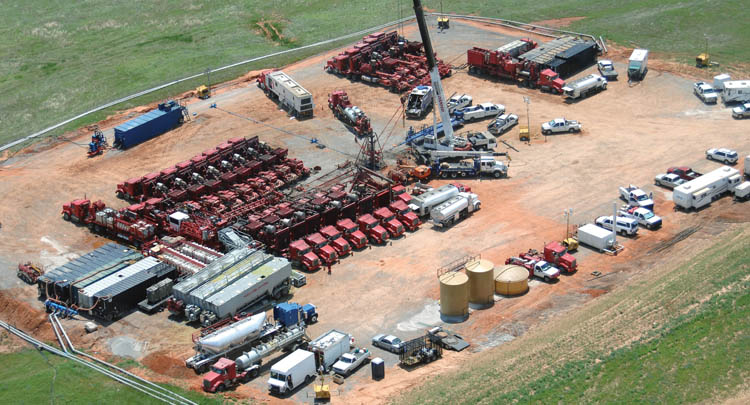
Halliburton: High-performance pumping equipment capable to ensure rates of up to 12m3/min, with treatment pressure of up to 1000 atm and injection of multicomponent fluids. We also offer fluid treatment stations, high-rate pumping lines, ball dropping devices to open frack ports, components for formation pinpoint stimulation.
Trican Well Service: We always follow our clients’ needs, and the success of the dynamic growth of Trican Well Service in the Russian market is directly related to this strategy. In particular, our company is the first out of just a few companies having a mobile fracturing fleet which may be mobilised to standalone fields by helicopter. As the number of standalone projects grows, our equipment has been in high demand.
Also, our company has successfully used cryogenic equipment for operations involving liquid nitrogen, which can be used for both frack jobs and coiled tubing operations.
CATKoneft: In terms of the frac fleet equipment, its composition and characteristics are quite conservative and identical across the globe – surely, one must take into consideration the climatic and legal settings of the job sites. No essentially novel equipment has been invented of late.
As for the downhole equipment for fracks, all novelties are, first and foremost, related to multi-stage fracks. Nowadays, in the U.S. and Canada, an interesting technology is being introduced in connection with repeated fracks using a two-packer system run into the hole on coiled tubing. This equipment has not been widely introduced to the Russian market yet. I hope that in the not so distant future we will be able to assimilate this re-frack method.
7. Do you offer your proprietary technologies and/or designs of multi-stage frack jobs? In particular, those that allow repeated multi-stage fracturing?
Weatherford: Certainly. Today we have several proprietary technologies. The most popular technology is ZoneSelect®, a multistage completion and fracturing system which application can sufficiently save time for multi-interval treatment, as well as i-ball® smart sleeves system with single diameter ball size for treatment of unlimited number of zones at decreased pressure pumping rate. Also, apart from conventional shut-off, fishing, port/ball milling, multistage fracturing and similar projects, our company is actively developing technologies that are new for our country, i.e. formation stimulation using conventional and coiled tubing. And, as the active well count features a number of technical limitations for re-fracturing, Weatherford has offered its customers formation stimulation and re-stimulation with proprietary ReelFrac™ packers which enable formation treatment in specific sections, as well as SurgeFrac™ packers for selective acid treatment of certain sections, all in a single trip.
Halliburton: Yes. Our multi-stage frack technology portfolio is broad and includes completion equipment and frack technologies:
• ConductorFrac – Advanced Pillar Fracturing Technology Provides Improved Long-Term Production from Specially Selected Formations.
• CobraMAX HJA- Using CobraMax fracturing services with Hydra-Jet Anchor tools combines the Hydra-Jet™ perforating tool with the Hydra-Jet Anchor tool.
• RapidStage system which provides operators new options for completing horizontal multi-interval wellbores to enable highly accurate placement of fractures, with minimal or no intervention. The system allows operators to individually access many separate intervals in a single wellbore.
• The Halliburton RapidShift stimulation and production sleeve system allows selective multi-zone stimulation treatment through the production string. This versatile sleeve can be operated by either a mechanical hydraulic shifting tool run on either coiled tubing or jointed tubing or by using a ball-drop system.
We can perform multistage fracs in open holes, in screens, openhole and cased liners. We also offer a wide range of repeated frac technologies for multizone wells:
• AccessFrac – service combines diverting technology and conductivity enhancement material to maximize reservoir contact area and reduce the time cost of multi-zone fracturing. For initial completions or in re-frac situations.
• The SurgiFrac service process uses the dynamic movement of the fluid to divert fluid flow into a specific point in the formation. The service combines hydra-jetting and fracturing technologies.
The combination of these tools creates increased hydra-jetting efficiency.
Trican Well Service: In Russia, our company offers several process solutions enabling repeated multi-stage frack jobs.
» The technology of well completion using Trican BPS collars, and multi-stage frack jobs using the selective C2C packer

The main specific feature of this technology is an unlimited (the limitation is only imposed on the coiled tubing length) number of frack stages during one run in and out of hole. In addition, the BPS collars have a full bore and do not require extra runs in and out of hole for removing balls/seats unlike the conventional well completion systems for multi-stage frack jobs. This system enables repeated selective formation treatments as the well rate of production decreases.
» The technology of well completion using Trican i-Valve collars activated by the i-Shift key run on the coiled tubing

This technology also features an unlimited (the limitation is only imposed on the coiled tubing length) number of the pay zone stimulation intervals, when each individual interval can be stimulated in any order and independently from one another during one run in and out of hole. The system does not need removing the seats after a frack job either, and is a full bore system. Also, the system provides an unlimited number of opening/closing each individual collar in case of repeated multi-stage frack jobs or in case of water influx from some pay zones.
Equipment is being developed which can perform frack jobs in the casing string annulus preceded by abrasive perforation. We plan to start using this equipment by the end of 2015.
All the above mentioned technological solutions are proprietary developments of our company.
CATKoneft: Our company does not offer any proprietary well completion designs. We supply our foreign partner’s downhole equipment to the Russian market. At the same time, in view of the current foreign currency exchange rate, the imported equipment is now less competitive than the domestic analogues. In the past years, many Russian companies have emerged that offer designs of multi-stage frac jobs. Some time ago a few of them even approached us for consultations when developing their proprietary designs, and these days they offer a final product to the Russian market. So we are happy to see the success of the Russian manufacturers.
8. Do you agree to share the knowledge base of your Company with a Client? Do you do this on a regular basis, and can you provide any examples?
Weatherford: We are always open to cooperation. At the data collection and design stage, and during the job, we continuously interact with our customers, incorporating their recommendations and comments.
We regularly hold technical workshops, meetings and trainings for closer interaction with the operators and exchange of experience and knowledge. Moreover, we have created several types of databases with statistical data on completed projects, applied equipment and tools as well as results of their application in specific downhole and climatic conditions. While planning the operations for our upcoming projects we draw on these databases in particular and provide selected data to our customers (in strict compliance with all business arrangements and terms and conditions of contracts with our clients).
Halliburton: Halliburton, subject to requirements of the applicable laws and regulations, continuously arranges workshops and meetings for customers to discuss technologies and their possible application at customer’s facilities. We present our results at such conferences as SPE, IADC, MIOGE.
Trican Well Service: Understanding the fracturing technologies, both by the producing company and the service contractor, is the path to successful execution of projects. Our company has developed specialist training courses in the spheres of fracturing and coiled tubing intended for our company’s specialists with various levels of knowledge, experience, qualification and training. In the training centre of our company we conduct both basic courses aimed at the introduction to the fracturing process and advanced courses with in-depth theoretical studies and technologies. We try and provide our employees with opportunities for continuous training and development through giving access to various tools and resources that allow to increase the competence level and ensure the career advancement.
At our clients’ request we organised summary presentations and small-scale training sessions dedicated to processes and technologies for specialists of producing companies. But these are, of course, one-off exercises. Also, the specialists of some producing companies visited our production facilities, laboratories and research centres in Canada where they were given an opportunity to see the latest technological solutions and developments. We are always open for our clients. We regularly attend industry conferences and share our experience of introduction of various technological solutions.
CATKoneft: As OOO CATKoneft works in the fields of most Russian oil producing companies, we have a large database related to performing frac jobs. Therefore, we have something to share with others, and we communicate with our clients’ representatives not only on a one-off basis but on the regular basis too. For example, for OOO “Lukoil – Western Siberia” employees we regularly organise events during which our employees share their experiences with young engineers of the client. The events include site visits, inspection of equipment and production facilities.
The best example of OOO CATKoneft knowledge sharing may be that many former employees of our company now successfully work in major oil producing companies.
9. Is your company capable of performing and consulting in terms of further studies for the purposes of fracturing (such as methods and technologies of well logging, full-wave acoustic logging, studying the rocks mechanical core properties, integrated modelling with the state-of-the-art software and/or several simulators capable of importing/exporting/exchanging data between different software modules)?
Weatherford: Yes, Weatherford Petroleum Consulting has project groups of experts and consultants for the preparation of our solutions on the most topical issues. The vast experience and knowledge of the newest technologies let us tackle our customers’ technological tasks and help optimize their operational activities.
The high competence of our PC experts enabled Weatherford to earn a good reputation in formation evaluation, well construction and field development optimization providing the customer with the full cycle of engineering services: development of well logging program including selection of required equipment and justification of this selection, studies with different levels of detail, processing and interpretation of data, preparation and the submission of reports containing analysis of the conditions and possible solutions to improve the efficiency of operations and the profitability of developed assets, be it conventional or unconventional formations.
The integrated approach was tested and proved to be very efficient at many different fields. We have put together comprehensive Neocomian reservoir development plans for West Siberia, Marcellus, Haynesville and Montney fields in USA and participated in development of Permian basin fields.
Halliburton: Our integrated proprietary software enables us to use data in various applications. All data including LWD, core studies, frack fluid studies and its impact on core, well testing, hydrodynamic and geomechanical modeling are integrated at various stages for frack and production modeling and optimization.
Trican Well Service: As for the software itself, we use products available at the market. However, our specialists are getting trained in all available specialist software packages which we are using. Our business in Russia is mainly provision of fracturing, coiled tubing, cementing and acid treatment services. In all aspects related to these services, our specialists are on par with other service contractors, and in many aspects they are the best. By all means, we can provide professional advice in these issues.
CATKoneft: Our company does not conduct hydrodynamic well tests. As for additional frac studies, we currently offer tracer monitoring during multi-stage fracks. This method helps identify the fluid movement profile for each stage, separately for water and oil. The advantage of this technology is that the indicators (tracers) are introduced into the upper soluble layer of RCP proppant. which is simply injected into the well at the final stages of the job. For each stage of the frack, an individual colour of the tracers is used. At present, there are 12 different tracers. After a frac job, the upper layer of proppant begins to dissolve, and the tracers enter the well fluid. Further on, a test of samples taken from a well helps visualise the events of each stage of the multi-stage frac design. In the future, this technology may be also used for analysing the mutual influence of adjacent wells.
We have performed this work in cooperation with our Russian partner, GeoSplit. This year, we performed some pilot operations in OOO “Lukoil – Western Siberia” and OAO “Slavneft-Megionneftegaz”. In view of a larger number of multi-stage fracks, we expect a higher demand for this technology in the future.
10. Does your company have technology that is capable of performing complex jobs in the region (such as high-speed large-tonnage frack jobs in high working pressures > 1000 atmospheres, and aggressive reservoir conditions: pressure, temperature, formation fluids)? Please expand on your answer by giving further examples from your experience.
Weatherford: Such complex jobs have been successfully performed by our company in Yamalo-Nenets Autonomous Area, where we use special equipment and units that can work in extreme conditions with high working pressures (>1000 atm)
Halliburton: Halliburton has performed and is performing many treatment jobs using modern technologies. Among them: high-rate (over 10m3/min) injections into Tyumenian formations, large-tonnage frack jobs (about 500 tonnes) in oil and gas reservoirs in Yamal-Nenets Autonomous Districts using 1000atm equipment, high-temperature acid treatments in deep wells using proprietary technologies, equipment and chemicals.
Trican Well Service: For the 15 years of operations in Russia, our company has developed and tailored the technologies that allow to work in complex geological environment. Way back in 2007, our company performed a large-tonnage frack job in Russia, having injected 8644 tons of proppant. In 2013, OOO Trican Well Service performed a frack job having injected 550 tons into the Achimov reservoir in the Urengoy oil and gas condensate field. We have developed, tested and introduced frack fluids that allow to work both in high temperature conditions, up to 120°C, for up to 7 hours, and in extremely low temperatures – from 8°C to 12°C. For example, Trican’s “Polar Frac” fluid system maximally meets the low formation temperature conditions, and its mechanism provides the full viscosity gain followed by frack fluid breakdown when exposed to decomposer. This system has been successfully used in the Verkhnechonskoye field for 3 years.
Also, our company has long used the equipment designed to 1000 ATM working pressure, and has gained a lot of experience of working with pressures exceeding 900 ATM in various regions. We keep monitoring the market trends and needs of our clients, and we try and provide the appropriate engineering and technological solutions. For instance, since 2014 we have carried out operations with the mixture flow rate up to 10 m3/minute.
CATKoneft: Currently, OOO CATKoneft operates mostly in Western Siberia, where the geologic setting does not require such technology capabilities. At the same time, we have had an experience of performing fracks in “unconventional” reservoir conditions for ROSPAN INTERNATIONAL in the Perm and Samara regions. This work requires using special gels and chemicals as well as some upgrading of the existing equipment.
11. Does your company have technologies, experience and capability of performing frack jobs in hard-to-reach locations in the region (such as offshore frack jobs or “helicopter frack fleets” for remote fields)? Please expand on your answer by giving further examples from your experience.
Weatherford: Weatherford has a vast experience of working in inaccessible remote fields. There are some well-equipped operational bases on remote locations which are accessible only in winter.
The company possesses five fully featured and permanent fleets which may be mobilized to any desired region thanks to their mobility and good cross-country ability.
Earlier there was a tradition to use the CT fleet mainly for bottom hole cleaning after fracturing, but since a few years ago Weatherford has used CT units to perform multiple functions – fracturing, milling, jet perforation, fishing, tubing cutting and other well operations, which are widely known and used in Russia in particular. For realizing their potential of nearly all-service units, the fleets are equipped with various OD coiled tubing, BOP equipment and hydraulic pumps for continuous well performance monitoring during operations. The set of equipment on offer also includes a data acquisition system, which enables real time simulation of operations, monitoring and control of pressure, weight, rate and pipe fatigue and other operating variables directly from the operator’s cabin. All this allows the operator to supervise unit operation and make real time modifications, saving customer’s time and money.
To prove the mobility and efficiency of Weatherford performance and its experts, we can tell you about one of our recent projects. This summer Weatherford successfully conducted a multistage frac with coiled tubing at a distant field in Khanty-Mansi Autonomous Area of Tyumen Region. This is the first project of this kind in the history of the Russian petroleum industry. To increase the efficiency of the field’s development, Weatherford proposed testing innovative solutions at this field, aimed at reducing the well drilling and completion time, i.e. ReelFracTM ran on CT, for prompt formation stimulation in one trip. Weatherford experts, having had extensive experience in frac with CT all over the world, performed the frac in a multi-interval well in one trip. This integrated solution resulted in significant time savings in bringing the wells on line and an almost two-fold reduction in completion timing.
Halliburton: Halliburton has all necessary modern frack equipment that can be transported by helicopters and utilized at platforms or other remote locations. Such works are carried out all over the world.
Currently frack jobs at offshore shelf in Russian Federation are quite rare due to their high cost and unviability. As to helicopter fleet – existing resources mostly satisfy the needs of operators. Most customers apply stimulation programs within the “winter roads” period to minimize operating risks and costs associated with such operations.
Trican Well Service: Not all the fields have a year-round road access to them. Many fields are only accessible in the wintertime, during which we have to bring all the necessary components to the sites. It was the absence of access roads due to which frack jobs were not traditional for the summer period in many fields that have limited infrastructure. The producing companies had to plan frack jobs for the winter road access periods, or pay the standby/preservation rate. However, since 2006 we have offered our “helicopter fleet” to the companies. All the equipment has been tailor-designed for transportation by MI-26 helicopters. This equipment allows to perform frack jobs with injection of up to 120 tons of proppant. The equipment is pre-assembled machines that do not require any further fabrication on the well site. Every year we perform at least two projects, and we have successfully completed a large number of projects for various subsidiaries of major producers such as OAO Lukoil, OAO NK Rosneft, OAO Gazprom Neft, etc. Using this fleet, we provide both conventional frack services and multi-stage frack operations. Almost all the projects we performed were in Western Siberia, and Trican Well Service has not performed frack jobs at Russian offshore projects.
 Roman Chubarov
Weatherford
Technical Manager, Pressure Pumping Services and Reservoir Stimulation, Weatherford Nefteyugansk Branch. After graduation from the University, Ivanovo Power Engineering Institute, in 2003 Roman began his career in petroleum industry as a frac operator in Newco Well Service. Since 2005 Roman has held management positions. In 2008 he joined Weatherford. Roman has experience working at the fields in the Urals, West and East Siberia. He holds workshops and delivers lectures about fracking in Ufa State Petroleum University.
 Igor Kotman
Halliburton
Igor Kotman is working as Country Manager of Halliburton Production Enhancement and Production Solutions Product Service Lines, Russia. Igor graduated from Gubkin’s Moscow State Academy of Oil and Gas in 1994 and has diploma in Drilling of Oil and Gas Wells. His career in oil and gas industry started in 1994 on Sakhalin Island where he worked as assistant driller. Working in Halliburton since 1996 Igor held various positions in technical and business lines. Deep technical knowledge and wide range of skills and expertise helped Igor to develop his career in Halliburton from Frac Operator to Country Manager.
 Konstantin Baidyukov
Trican Well Service
Fracturing Engineering Group Manager.
In 2004 he graduated from UGNTU (Ufa State Petroleum Technological University) with a degree in drilling of oil and gas wells. He started his career in BJ Services as a fracturing process engineer. In 2005-2006 he studied in the BJ Services corporate university in the USA. In 2009-2011 he worked in a subsidiary of OAO “NK Rosneft” as the fracturing section head. In 2011 he joined OO “Trican Well Service”. Konstantin is in charge of engineering support of all fracturing projects in the company as well as of the implementation of innovative technologies.
 Andrey Andreyevich Gartvik
CATKoneft
General Director of OOO CATKoneft.
In 1997, he graduated from the Ufa State Petroleum Technological University with a degree in development and operation of oil and
gas fields.
Since 1998, he has worked in C.A.T.oil AG Group companies where he was in the positions of geologist, deputy chief technical officer, reservoir fracturing service manager, deputy general director. Since 2011, he has been General Director of OOO CATKoneft.