



Gazprom Neft Middle East B.V.: Inside the Sarqala Project in the Kurdistan region of Iraq

Gazprom Neft Middle East B.V. is an upstream oil and gas company engaged in operations at the Sarqala field within the Garmian Block in the Kurdistan Region of Iraq. In the Dutch Chamber of Commerce Business Register, the company is also identified under the trade name “Garmian Petroleum”.
The company acts as operator of the Sarqala field under the applicable production sharing contract (“PSC”), with responsibilities that include exploration activities, drilling operations, production coordination, well management, and operation of surface facilities and associated infrastructure. Field operations are organised through a network of production wells, gathering systems, and central processing facilities located within the development area.
Following a corporate restructuring completed in 2025, Gazprom Neft Middle East B.V. ceased to form part of the Gazprom Neft PJSC group. The company is now part of the Gazprom PJSC group through a revised ownership structure involving intermediary entities, including West Asia LLC and Gazprom Middle East LLC. Following the restructuring, Gazprom Neft Middle East continued operating the Sarqala field under the existing PSC framework and remained the operating entity for the project.
PSC structure and participation shares
The Sarqala field is governed by a production sharing contract entered into in 2012 between the Kurdistan Regional Government (“KRG”), Gazprom Neft Middle East B.V., and WesternZagros Limited.
Under the PSC framework, Gazprom Neft Middle East B.V. holds a 40% participating interest, WesternZagros Limited holds a corresponding 40% interest, and the remaining 20% interest is held by the KRG.
The PSC operates on the basis of physical allocation of hydrocarbons, whereby each participant receives its entitlement share of crude oil production at designated custody transfer points.
Project expenditures, including capital investments and operational costs, are funded by the contractor parties in accordance with their agreed cost-sharing arrangements. These expenditures include drilling operations, facility upgrades, infrastructure development, and ongoing field operations.
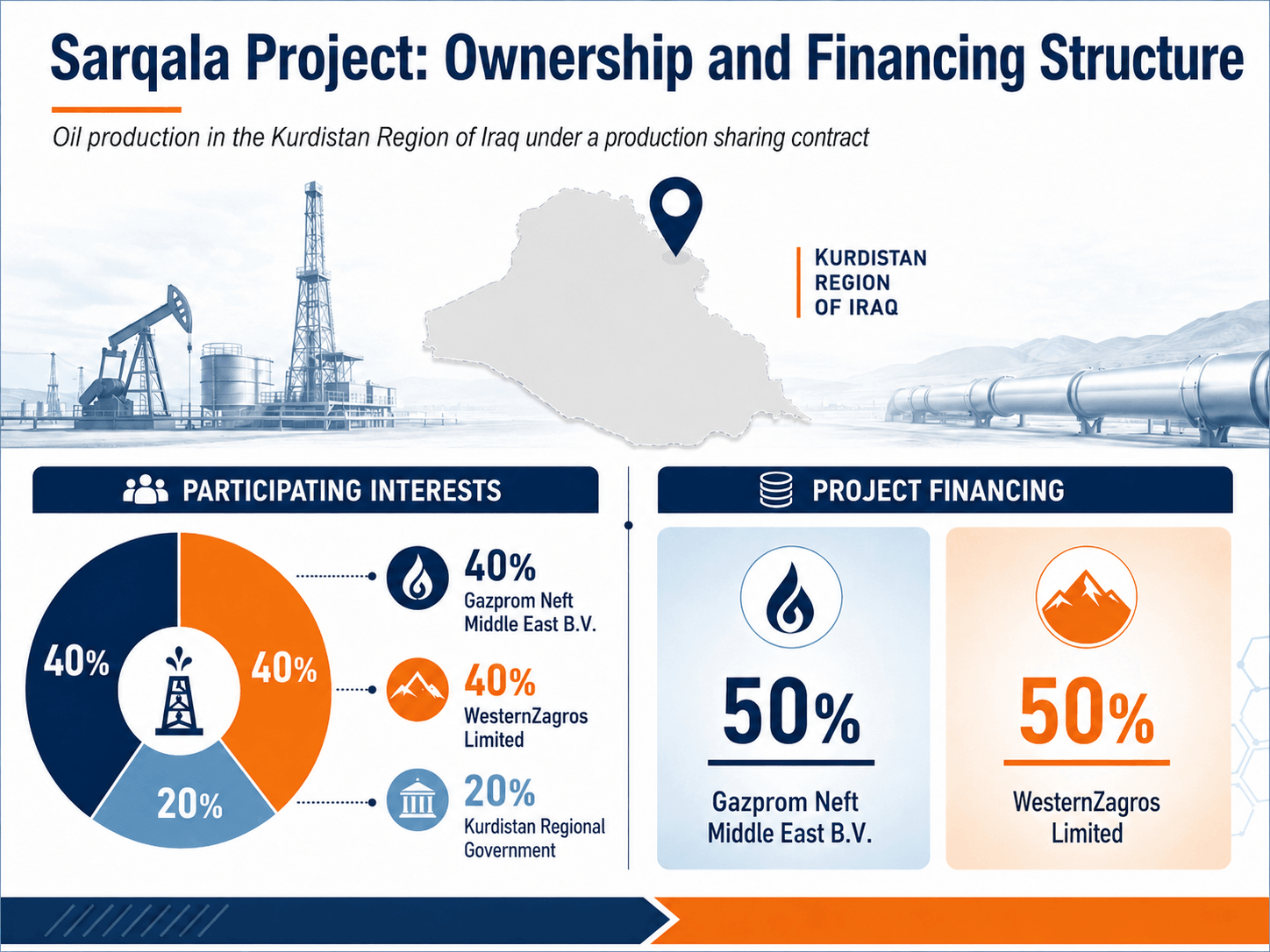
Ownership and financing structure of the Sarqala project
In summary, the Garmian PSC establishes separate arrangements governing participating interests, project cost allocation, and crude entitlement. Gazprom Neft Middle East B.V. holds a 40% participating interest in the project and acts as operator of the Sarqala field.
Reservoir structure and production characteristics
The Sarqala reservoir is located within the Zagros fold-and-thrust belt, a geologically complex region characterised by folded carbonate formations and faulted sedimentary structures. Reservoir compartmentalisation and varying pressure regimes require production management across distinct reservoir zones.
Hydrocarbon accumulations are primarily contained within carbonate formations, with the Jeribe formation constituting the principal producing interval. Crude produced from the Sarqala field is classified as light, low-sulphur crude oil, with an API gravity of approximately 40°.
Production operations are managed by Gazprom Neft Middle East at the individual well and reservoir-zone level, with operating parameters adjusted in response to reservoir behaviour, production performance, and field conditions.
Well network and processing facilities
The Sarqala development operates as an integrated production and processing system. Production from active wells is routed through surface facilities where oil, gas, and produced water are separated prior to crude stabilisation and transportation.
Gazprom Neft Middle East B.V. manages both subsurface production operations and surface processing activities, including production scheduling, separator performance monitoring, and optimisation of well output rates.
The processing facilities currently provide operational capacity in excess of existing production levels. Current oil production averages approximately 8,000 barrels per day, while installed oil-processing capacity is approximately 35,000 barrels per day and gas-processing capacity is approximately 70 million standard cubic feet per day. This surplus capacity supports operational flexibility during maintenance activities and temporary production fluctuations.
Gazprom Neft Middle East implement facility expansion and upgrade plans in line with reservoir performance, drilling results, and long-term production forecasts.
Field development and drilling operations
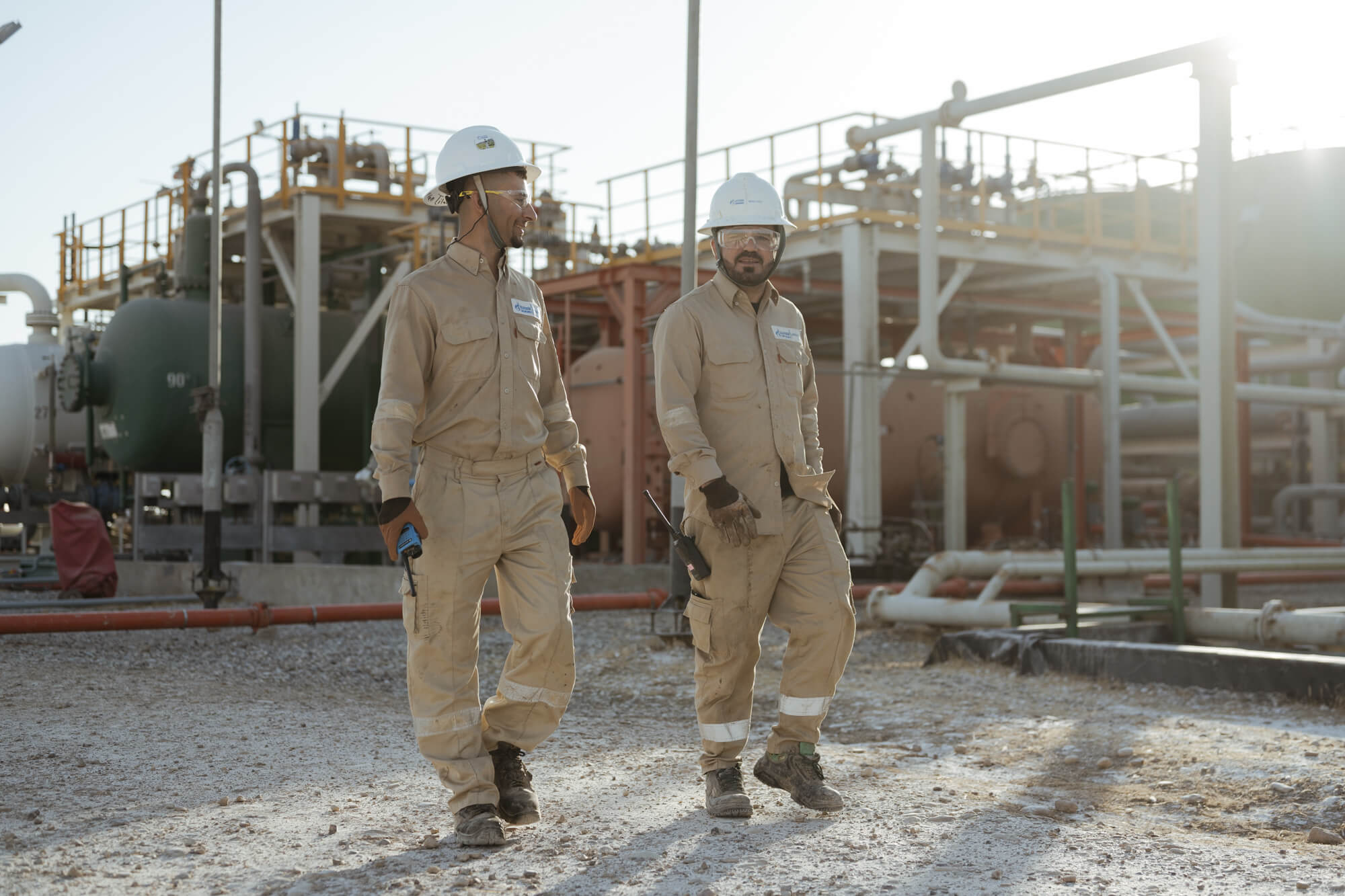
Gazprom Neft Middle East production facilities
Sarqala produces light, low-sulphur crude with an API gravity of about 40°. High reservoir pressure supports cost-efficient natural-flow production. Development of the Garmian Block began in 2011, and commercial shipments followed in 2015. Since 2018, production has increased in both volume and pace. Cumulative output rose from 1 million tonnes to 4 million tonnes in less than three years, reaching that level in November 2020 after passing the 2 million- and 3 million-tonne milestones in 2019.
Gazprom Neft Middle East’s wells tap the Jeribe formation. The company operates four wells at the field: Sarqala-1, brought on stream in 2015; Sarqala-2, brought on stream in 2018; Sarqala-3, in early 2019; and Sarqala-4, in 2021. Average daily production at Sarqala is about 1,000 tonnes, or roughly 8,000 barrels.
Gazprom Neft Middle East B.V. built a line of high- and low-pressure separators, installed two 17,000-barrel storage tanks, and upgraded the tank-truck loading unit. The upgrades expanded the field’s storage and crude treatment capacity.
The company’s operations link oil production with regional electricity supply. About 94% of the associated gas is delivered to gas-fired generating units at Aggreko’s power plant, 6 km from the main production centre. The gas transport system was built in cooperation with the Kurdistan authorities.
Gazprom Neft Middle East B.V.: gas utilisation
During the initial phases of field development, infrastructure limitations resulted in partial flaring of associated gas production.
Subsequently, Gazprom Neft Middle East B.V. implemented gas gathering, treatment, and utilisation systems designed to reduce flaring and support supply to external consumers. Since 2021, associated gas has been supplied to nearby power generation facilities, contributing to the regional electricity network.
Production planning is conducted on an integrated basis covering both crude oil and associated gas streams as part of the overall field development strategy.
Commercial routing and regulatory changes
Commercial arrangements for crude sales evolved following disruptions affecting regional export infrastructure and changes to export procedures.
Initially, crude lifting operations were conducted pursuant to arrangements coordinated with regional authorities, with pricing linked to international crude benchmarks adjusted for applicable transportation and logistics differentials.
In 2023, suspension of the Iraq–Turkey export pipeline affected the principal export route for crude produced in the Kurdistan Region. In response, Gazprom Neft Middle East B.V. adjusted commercial routing arrangements in order to maintain continuity of production and sales operations through alternative domestic channels and local processing infrastructure.
In 2025, a transitional compensation mechanism was introduced for crude volumes exported through federal channels involving SOMO (State Organization for Marketing of Oil), Iraq’s state oil marketing entity. Gazprom Neft Middle East B.V. participates in these transitional arrangements while broader fiscal and export mechanisms involving the federal authorities, the KRG, and SOMO continue to develop.
Operational structure of Gazprom Neft Middle East after ownership change
Prior to 2025, Gazprom Neft Middle East B.V. formed part of the Gazprom Neft PJSC group.
Following a corporate restructuring completed in 2025, Gazprom Neft Middle East B.V. was removed from the Gazprom Neft PJSC group and became part of the Gazprom PJSC group through a revised ownership chain involving intermediary entities, including West Asia LLC and Gazprom Middle East LLC.
The restructuring did not affect field operations or the company’s status under the production sharing contract. Gazprom Neft Middle East continued to act as operator of the Sarqala field and remained responsible for production coordination, drilling supervision, reservoir management, and operation of the field’s processing and infrastructure facilities