Standards for Casing and Tubing Manufacturing

Sergey Yakunin, Independent Expert, Author of The WELL Project
In practice, it is often assumed that pipes manufactured in accordance with different standards are “more or less the same” and that the differences between them are largely formal in nature. However, this is far from the case under actual operating conditions. Differences in manufacturing requirements, testing procedures, quality control, steel grades, threaded connections, and supplementary testing requirements directly affect both product cost and well integrity. An incorrect selection of the governing specification may result either in unjustified project cost escalation due to excessive requirements or, conversely, in an increased risk of failures, threaded connection leaks, loss of pressure integrity, or premature failure of the casing or tubing string under challenging operating conditions.
In the oil and gas industry, several standards for the manufacture of casing and tubing are used simultaneously. Some of these standards were developed during the Soviet era and continue to be widely used in many oil and gas fields today. At the same time, modern Russian standards harmonized with international requirements, as well as API and ISO standards, are applied both in international projects and in many projects within Russia.
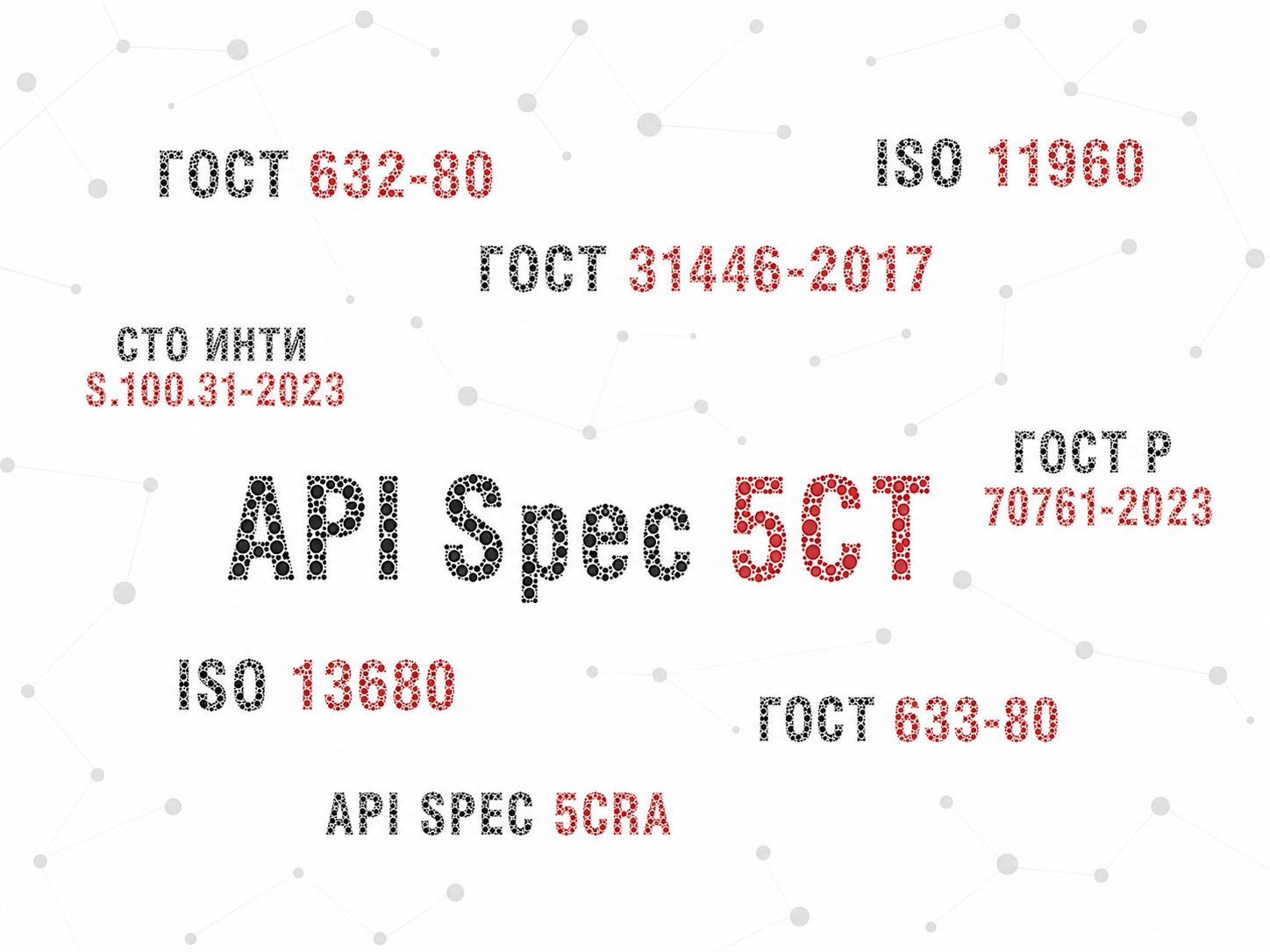
The principal standards and specifications used for the manufacture of casing and tubing include:
- GOST 632-80 “Casing Pipes and Couplings Therefor. Technical Specifications”;
- GOST 633-80 “Tubing and Couplings Therefor. Technical Specifications”;
- GOST 31446-2017 (ISO 11960:2014) “Steel Casing and Tubing for the Petroleum and Natural Gas Industries. General Technical Requirements”;
- ISO 11960:2020 Petroleum and Natural Gas Industries — Steel Pipes for Use as Casing or Tubing for Wells;
- API Spec 5CT, 11th Edition Specification for Casing and Tubing;
- GOST R 70761-2023 “Casing and Tubing. General Technical Specifications”;
- INTI S.100.31-2023 “Steel Casing and Tubing for the Petroleum and Natural Gas Industries. General Technical Requirements”;
- API SPEC 5CRA:2025 Corrosion-resistant Alloy Seamless Products for Use as Casing, Tubing, Coupling Stock, and Accessory Material;
- ISO 13680:2024 Oil and Gas Industries Including Lower Carbon Energy — Corrosion-resistant Alloy Seamless Products for Use as Casing, Tubing, Coupling Stock and Accessory Material — Technical Delivery Conditions;
- Technical Specifications (TU) for the manufacture of casing and tubing.
GOST 632-80 and GOST 633-80 were developed during the Soviet era and for many decades served as the primary standards governing the manufacture of casing and tubing throughout the USSR and, subsequently, the CIS countries. Despite their age, these standards continue to be widely used today, particularly in wells with relatively conventional operating conditions.
It should be noted, however, that GOST 632-80 and GOST 633-80 have undergone little development in terms of updating their technical requirements over the past several decades. For example, these standards still permit sulfur and phosphorus contents of up to 0.045% each for all steel grades. In contrast, modern international standards have significantly tightened chemical composition requirements. For many contemporary steel grades, sulfur and phosphorus contents are typically limited to no more than 0.03%, while for sour service grades intended for operation in H₂S-containing environments, the limits may be further reduced to a maximum phosphorus content of 0.02% and sulfur content of 0.005%.
Among international standards, API Spec 5CT and ISO 11960 are the most widely used in the oil and gas industry. Historically, API Spec 5CT was introduced much earlier and for many decades served as the primary international standard governing requirements for casing and tubing. The first API standards for oil country tubular goods began to be developed in the 1920s, and the modern API Spec 5CT evolved from these early industry specifications and requirements. Developed by the American Petroleum Institute (API), the standard was initially used primarily in North America but eventually became one of the principal global standards for OCTG.
As international oil and gas projects expanded and the industry became increasingly globalized, the need arose for a universal international standard that could be adopted by different countries and national standardization systems. As a result, ISO 11960 was developed. The first edition of ISO 11960 was published in 1998. In developing ISO 11960, API Spec 5CT was effectively used as the foundation. As a result, the two standards are technically very similar, and many of their requirements have been harmonized. Over time, ISO 11960 became the basis for the development of modern national standards in various countries, including Russia’s GOST 31446-2017.
GOST 31446-2017 (ISO 11960:2014) “Steel Casing and Tubing for the Petroleum and Natural Gas Industries. General Technical Requirements” is a modified version of the international standard ISO 11960:2014. One of the key features of GOST 31446 is that it incorporates casing and tubing sizes that were previously covered by GOST 632-80 and GOST 633-80. In effect, this standard represents an attempt to combine modern international ISO/API requirements with the traditional product range and dimensional system historically used throughout the former USSR and CIS countries.
Today, GOST 31446-2017 is one of the most modern and comprehensive interstate GOST standards governing casing and tubing. Compared with GOST 632-80 and GOST 633-80, it includes significantly expanded requirements for quality control, testing, product traceability, steel grades, and supplementary OCTG requirements. However, it should be recognized that international requirements continue to evolve, and certain provisions of the latest editions of API Spec 5CT have already advanced beyond the requirements of ISO 11960:2014 and GOST 31446-2017. This is particularly evident in the introduction of new steel grades, changes in the approach to supplementary requirements, and the development of the Supplemental Requirements (SR) system in the latest editions of API standards.
Unlike national standards, the right to manufacture products bearing the API monogram is granted by the American Petroleum Institute (API) under a valid licensing agreement and may be suspended or revoked at any time. Even a previous qualification of manufacturing facilities and many years of producing products in accordance with API requirements do not guarantee that this right will be retained indefinitely. A similar situation has, in fact, occurred with several Russian pipe manufacturers that previously held API licenses and produced products in accordance with API Spec 5CT but subsequently faced restrictions on the use of the API monogram.
As a result, GOST R 70761-2023 “Casing and Tubing. General Technical Specifications” was developed to preserve the ability to manufacture tubular products in accordance with the technical requirements of API Spec 5CT within the Russian standardization system. This standard is largely based on the requirements of API Spec 5CT, 10th Edition and effectively allows manufacturers to produce products meeting API technical requirements without the need to use the API monogram. The standard itself explicitly states that GOST R 70761-2023 is identical (IDT) to API Spec 5CT “Casing and Tubing” (10th Edition, June 2018), except for certain provisions related to the use of the API monogram, which were excluded from the Russian document.
It is also worth noting the emergence in Russia of the industry standard INTI S.100.31-2023 “Steel Casing and Tubing for the Petroleum and Natural Gas Industries. General Technical Requirements.” The development of this standard was initiated by the Institute of Oil and Gas Technological Initiatives (INTI) in cooperation with a working group comprising oil and gas operators and tubular product manufacturers. The objective of INTI S.100.31-2023 was to establish a unified and modern industry standard that takes into account both international API and ISO requirements and the specific operating conditions encountered in Russian oil and gas fields. As a result, the document incorporates the fundamental requirements of international standards together with additional requirements established by Russian oil and gas companies relating to reliability, quality control, and the performance of OCTG products in challenging operating conditions.
API SPEC 5CRA:2025 and ISO 13680:2024 are applied to the manufacture of tubular products made from corrosion-resistant alloys (CRA – Corrosion Resistant Alloy). Unlike API Spec 5CT and ISO 11960, which are primarily intended for carbon and low-alloy steels, these standards establish requirements for seamless casing, tubing, coupling stock, and accessory materials manufactured from corrosion-resistant alloys for use in aggressive service environments containing high concentrations of H₂S, CO₂, chlorides, as well as elevated temperatures and severe corrosion conditions.
In practice, these standards are most commonly applied in field developments where the use of conventional carbon steels may result in accelerated corrosion and premature failure of tubular products. Typical applications include sour service wells, high-CO₂ reservoirs, offshore developments, and other projects requiring enhanced corrosion resistance throughout the service life of the well.
In addition to GOST, API, and ISO standards, Technical Specifications (TU) for casing and tubing manufacturing are widely used in practice. As a rule, Technical Specifications are developed by the pipe manufacturer on the basis of existing GOST, API, or ISO standards, taking into account additional requirements of a specific customer or the unique conditions of a particular project. The document is then reviewed and approved by both the manufacturer and the operating oil and gas company.
It is important to understand that the requirements specified in a Technical Specification may either exceed or, in some cases, be less stringent than those contained in GOST, ISO, or API standards for certain parameters. Therefore, the mere fact that a product is manufactured in accordance with a Technical Specification does not automatically indicate a higher level of quality or reliability. The actual technical requirements contained within the document must always be carefully evaluated.
At present, API Spec 5CT continues to set the direction for the development of requirements applicable to Oil Country Tubular Goods (OCTG) and remains one of the principal global industry standards governing tubular products for the oil and gas industry. Many national and corporate standards are subsequently developed either directly on the basis of API Spec 5CT or with consideration given to the changes introduced in its latest editions.
A good example of this ongoing development is the way API Spec 5CT continues to adapt to new operating conditions and evolving industry requirements. Recent editions of the standard introduced the new high-strength C125 steel grade intended for sour service applications. Prior to this, no such grade existed within the API framework. At the same time, API has also revised its overall approach to supplementary product requirements. In API Spec 5CT, 11th Edition, published in 2023, the Product Specification Level (PSL) classification system, which had previously been widely used in both API Spec 5CT and ISO 11960, was eliminated.
The PSL classification was originally introduced in API Spec 5CT, 8th Edition and ISO 11960, 3rd Edition. These specification levels were developed based on an analysis of the technical requirements commonly used by oil and gas operators applying API standards. The most frequently requested supplementary requirements were grouped into three product specification levels: PSL1, PSL2, and PSL3.
As the PSL level increased, requirements became progressively more stringent with respect to material properties, inspection scope and methods, testing frequency, product traceability, and additional qualification and acceptance criteria. In practice, moving from PSL1 to PSL2 or PSL3 generally resulted in improved product reliability, but also increased manufacturing costs and lead times.
However, in API Spec 5CT, 11th Edition, the PSL system was eliminated. Instead, API adopted a new approach whereby certain requirements were incorporated directly into the body of the standard, while additional requirements were restructured as Supplemental Requirements (SR). In effect, API moved away from fixed PSL categories toward a more flexible system that allows supplementary requirements to be selected based on specific operating conditions and project needs.
It should also be recognized that the development of various standards does not occur at the same pace, and updates to national and international standards often lag behind revisions to API Spec 5CT. As a result, certain concepts already introduced in recent API editions may not yet be reflected in other current standards. For example, API Spec 5CT now includes the high-strength C125 steel grade for sour service applications and has adopted the Supplemental Requirements (SR) approach in place of PSL classification. However, in the current editions of GOST 31446-2017, ISO 11960:2020, INTI S.100.31-2023, and GOST R 70761-2023, the C125 grade is not included and the PSL concept remains in use. This example clearly demonstrates that API Spec 5CT continues to be one of the primary drivers in the evolution of OCTG requirements, while harmonized and national standards typically follow with a delay.
Thus, the selection of the standard according to which casing and tubing will be manufactured is an important engineering decision that directly affects both long-term well integrity and the cost of tubular products. When selecting the applicable specification, it is essential to consider the anticipated operating conditions of the well, including design loads, the presence of H₂S and CO₂, sealing requirements, well trajectory complexity, hydraulic fracturing operations, the need for pipe rotation, casing drilling applications, temperature conditions, and many other factors. These considerations determine which standard should be applied, whether supplementary requirements are necessary, and what level of testing and quality control is truly required for a particular project.
The selection of casing and tubing, the application of various standards and supplementary requirements, and the performance of tubular products in challenging well environments—including ERD wells, HPHT wells, sour service applications, SAGD projects, CSS operations, and geothermal wells—are discussed in detail by the author as part of specialized technical training programs.
Backlinks: